AI Resume Screening: How It Works (Complete Guide for Recruiters in 2026)
Written by Ahmed Awan, Founder of OperationOS
• Reading time: 12 min
Roles can attract more applications than a hiring team can review efficiently in one pass. AI-assisted resume screening can organize an initial review while keeping hiring decisions under human control.
For a lot of recruiters and hiring managers, that phrase lands somewhere between relief and suspicion. Relief, because sorting through hundreds of resumes by hand is one of the least enjoyable parts of the job. Suspicion, because nobody wants a black box deciding who gets an interview or worse, quietly replacing the people who used to make that call.
The good news is that AI resume screening, done well, doesn't have to be either a miracle cure or a threat to your job. It's a tool, a genuinely useful one, that handles the repetitive, pattern-matching part of screening so recruiters can spend their time on the part that actually requires human judgment: talking to people.
This article breaks down what AI resume screening actually is, how it works under the hood, where it falls short, and how to use it in a way that makes your hiring process faster without making it worse.
What Is AI Resume Screening?
AI resume screening is the use of machine learning models, usually large language models (LLMs), to read resumes, compare them against a job description, and produce a structured assessment of how well a candidate matches the role.
In practice, this usually looks like:
- Extracting the text and structure from a resume (work history, skills, education, dates)
- Comparing that information against the requirements in a job description
- Scoring or ranking candidates based on relevance
- Highlighting specific strengths, gaps, or red flags for a human to review
The keyword is "assessment," not "decision." A well-designed AI resume screening tool doesn't reject or hire anyone. It produces information, a match score, a summary, and a list of matching and missing skills that a recruiter then uses to decide who moves forward.
This is different from older resume filtering tools, which is a distinction worth sitting with for a moment.
AI Screening vs. Traditional ATS Filtering
Applicant tracking systems (ATS) have used automated resume filtering for over a decade. Most of that filtering has historically relied on keyword matching: does the resume contain the words "Python," "project management," or "5 years"? If not, the resume gets buried or auto-rejected.
AI resume screening, particularly systems built on modern language models, can compare semantic context and related terms rather than scanning only for exact keyword hits. The quality of that comparison depends on the model, instructions, source material, and review process.
Why Manual Resume Screening Is Inefficient
Before getting into how AI screening works, it's worth being honest about why it exists in the first place. Manual resume screening has real, well-documented problems.
It doesn't scale. A single job posting on a popular platform can attract anywhere from dozens to hundreds of applicants. Recruiters and hiring managers who are already juggling interviews, stakeholder meetings, and offer negotiations often only have a few seconds to skim each resume. Initial review can become increasingly time-constrained as the application queue grows.
It's inconsistent. The same resume reviewed by two different recruiters or even the same recruiter on two different days can get different outcomes depending on fatigue, mood, or how many resumes came before it. This isn't a character flaw; it's just how human attention works under repetitive load.
It's slow. Every day a role stays open costs money, momentum, and sometimes the best candidates, who accept offers elsewhere while your team is still working through a stack of applications.
It's prone to bias, including unconscious bias. Names, schools, employment gaps, and formatting choices can all subtly influence how a resume is perceived, regardless of the reviewer's intentions. This is one of the most-cited reasons organizations began experimenting with structured, criteria-based screening in the first place, automated or not.
None of this means recruiters are bad at their jobs. It means resume screening, as a task, is fundamentally repetitive and volume-heavy exactly the kind of task where automation tends to help, as long as it's built and used thoughtfully.
How AI Resume Screening Works
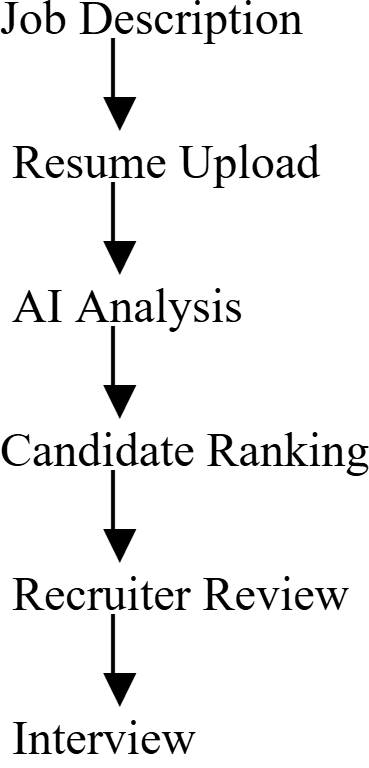
Here's what actually happens, step by step, when an AI resume screening tool processes a candidate.
- Job Description
- Resume Upload
- AI Analysis
- Candidate Ranking
- Recruiter Review
- Interview
Step 1: Parsing the Resume
The first job is simply extracting usable text and structure from whatever format the resume arrives in, whether PDF, Word document, or plain text. This step identifies sections like work experience, education, skills, and dates, turning an unstructured document into something the system can reason about.
Step 2: Understanding the Job Description
The tool also processes the job description as more than a list of keywords. It treats it as a set of requirements: required skills, years of experience, seniority level, and sometimes softer signals like domain background or leadership scope.
Step 3: Comparing Candidate to Role
This is where the actual "AI" part does its work. Instead of doing a literal string match ("does this resume contain the word 'SQL'?"), a language-model-based system can recognize that a candidate who lists "PostgreSQL" or "database query optimization" likely has relevant SQL experience, even without the exact word appearing.
It can also weigh context: three years as a "Marketing Coordinator" managing a full campaign budget reads differently than three years as a "Marketing Coordinator" doing administrative support. A good system tries to capture that nuance rather than treating both resumes as identical matches.
Step 4: Producing a Structured Output
The final step is turning that analysis into something a recruiter can actually use, typically a match score, a short summary or recommendation, a list of matching skills, a list of missing or weaker areas, and any notable concerns (like an unexplained employment gap or a mismatch in seniority level).
This structured output is the whole point. A resume screening tool that just says "78% match" without explaining why isn't actually helping anyone make a better decision; it's just adding a number to be second-guessed. The more useful tools show their reasoning.
AI vs. Keyword Matching: What's Actually Different
It's worth slowing down on this distinction, because a lot of skepticism about "AI resume screening" is really skepticism about older keyword-matching systems that got mentally lumped in with newer AI tools.
Keyword matching looks for exact or near-exact terms. If a job description says "customer relationship management" and a resume says "CRM," a purely keyword-based system might miss the connection entirely. This is how a genuinely qualified candidate can get filtered out for using different (but equivalent) language than the job posting.
AI-based screening, using language models, is designed to understand meaning rather than just matching strings. It can recognize that "led a team of 6 engineers" and "managed an engineering team" describe similar experience, even though the words don't overlap much. It can also connect adjacent skills, recognizing that someone experienced with React likely has transferable frontend fundamentals, even for a role that lists a different framework.
This doesn't make AI screening infallible. A system may compare relevance beyond literal vocabulary, while its output still needs human review and validation against the role.
| Traditional ATS | AI Resume Screening |
|---|---|
| Matches keywords | Can compare semantic context |
| Often keyword-dependent | Recognizes similar skills |
| Basic filtering | Model-assisted ranking |
| Often limited explanation | Can provide supporting factors |
| Can miss qualified candidates | Can recognize related experience |
Benefits for Recruiters
Used well, AI resume screening gives time back to the people doing the hiring, in a few concrete ways.
- Faster first-pass review. Instead of manually reading every resume in a pile of 200, a recruiter can start with a ranked, summarized view and focus their attention where it's most likely to matter.
- More consistent baseline evaluation. Because the tool applies the same criteria to every resume, it reduces the variability that comes from reviewer fatigue or inconsistent standards across a hiring team.
- Clearer documentation. A structured breakdown of why a candidate was flagged as a strong or weak match creates a record that's useful for calibrating with hiring managers, revisiting decisions and, increasingly, for compliance and audit purposes.
- More time for actual recruiting. This is the underrated one. The hours saved on screening are hours that can go into sourcing passive candidates, having better conversations with applicants, and improving the candidate experience. Those are the parts of the job that build a strong employer brand and can't be automated.
Common Misconceptions About AI Resume Screening
"AI screening means an algorithm decides who gets hired." In a well-designed system, AI screening informs a decision; it doesn't make one. Final decisions about who to interview and hire remain with people.
"AI is objective, so it removes bias entirely." AI systems are trained on data, and data reflects real-world patterns, including biases. AI screening can reduce certain kinds of inconsistency, but it doesn't automatically eliminate bias, and tools should be evaluated and monitored for fairness, not assumed to be neutral by default.
"AI screening only works for high-volume roles." While it's most obviously valuable when there are hundreds of applicants, even smaller hiring pipelines benefit from faster, more consistent first-pass review and clearer documentation of why candidates were shortlisted.
"If you use AI, you don't need recruiters to review resumes anymore." This is probably the biggest misconception, and it deserves its own section.
Can AI Replace Recruiters?
No. It's worth being direct about why.
Resume screening is one task within recruiting, not the whole job. Recruiters interpret ambiguous or unconventional career paths (a candidate who switched industries, took time off, or built an unusual combination of skills). They read between the lines of a job description to understand what a hiring manager actually needs, which isn't always what's written down. They negotiate, persuade, manage candidate experience, and make judgment calls in situations with no clean data to point to.
AI tools can support structured comparison across a large volume of documents, but they cannot supply a hiring team's full context, accountability, or judgment. Recruiters still need to examine unconventional experience, question the output, and decide what matters for the role.
The realistic framing is this: AI resume screening handles the first pass so recruiters can spend more of their time on the parts of hiring that require actual human judgment, not less of it.
Best Practices for Using AI Screening Ethically
If you're evaluating or already using AI in your resume screening process, a few practices go a long way:
- Keep a human in the loop. AI output should inform recruiter decisions, not replace them. No candidate should be rejected purely by an automated score with no human review.
- Understand what the tool is actually evaluating. Ask vendors to explain, in plain language, what criteria the system weighs and how it generates its recommendations. If a vendor can't explain this clearly, that's worth treating as a red flag.
- Prioritize explainability over a single score. A match percentage on its own is nearly useless. Look for tools that show their reasoning, including which skills matched, which are missing, and why a recommendation was made, so recruiters can sanity-check the output rather than blindly trusting it.
- Audit for fairness periodically. Review outcomes across different candidate groups to check whether the tool is producing consistent, defensible results over time.
- Be transparent with candidates. Depending on your jurisdiction, you may be legally required to disclose the use of automated tools in hiring decisions. Even where it's not required, it's good practice for maintaining candidate trust.
- Treat AI screening as a first filter, not a final answer. The goal is to help recruiters focus their attention, not to make the human review step optional.
How RecruitOS Approaches AI Resume Screening
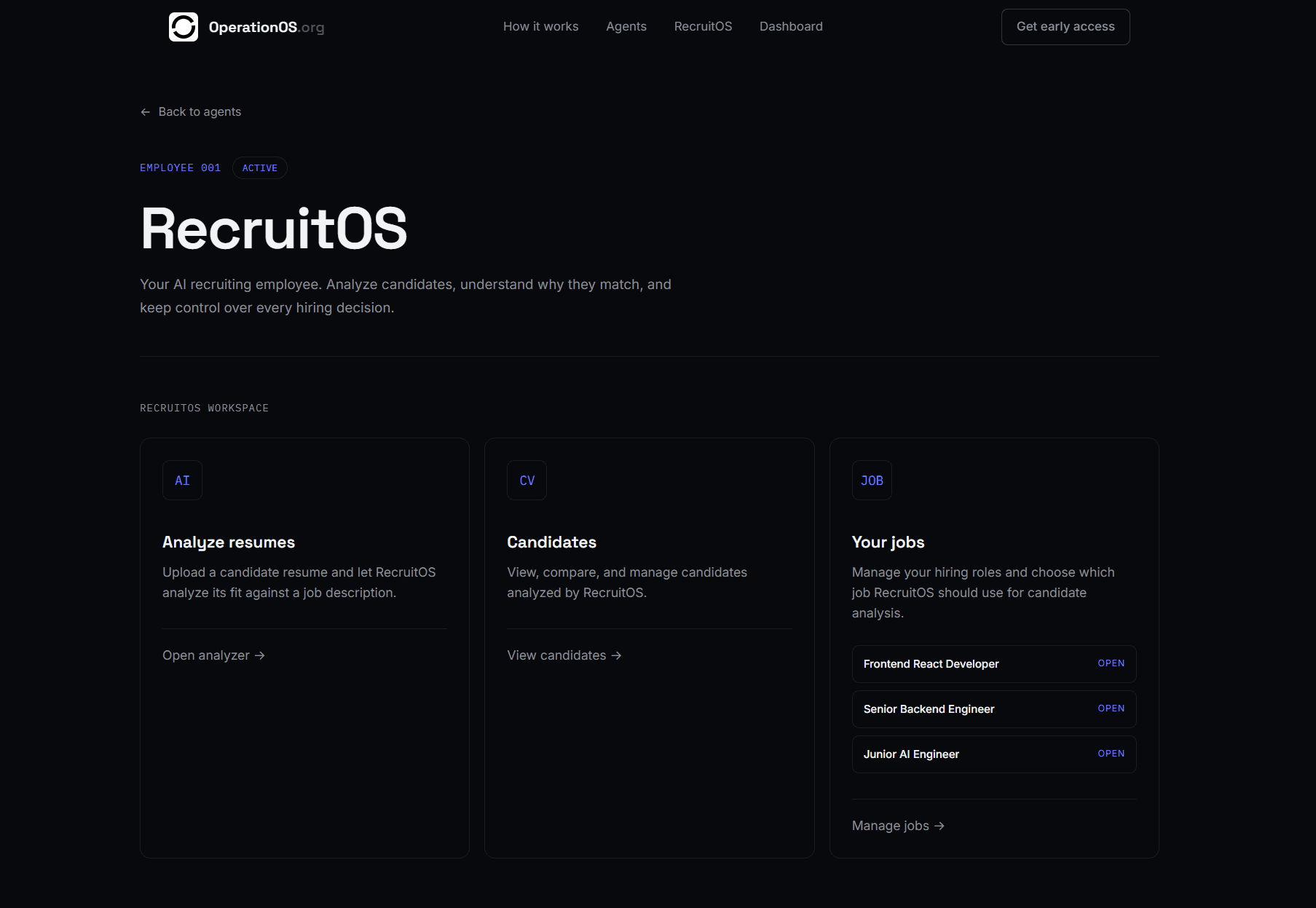
At OperationOS, RecruitOS is designed around a clear boundary: AI-assisted review should support recruiters, not replace their judgment.
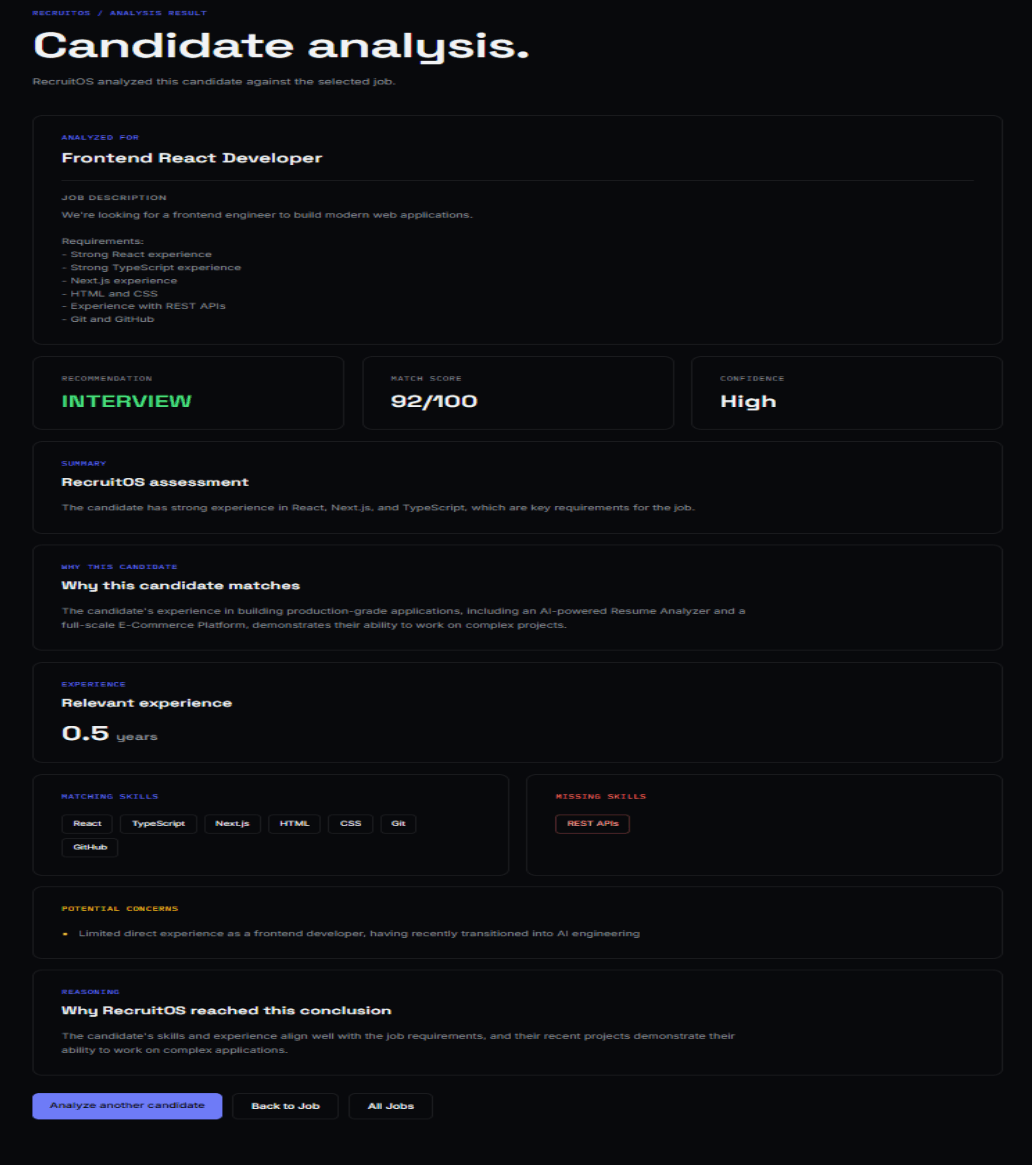
RecruitOS analyzes a candidate's resume against a specific job description and returns a structured evaluation rather than a bare score. That evaluation includes a match assessment, a clear recommendation, a breakdown of the candidate's matching skills against the role's requirements, the skills or experience that appear to be missing, and any concerns worth a recruiter's attention, like gaps or mismatches in seniority.
The goal of that structure is explainability. Instead of asking a recruiter to trust an opaque number, RecruitOS shows the reasoning behind its recommendation, so the recruiter can quickly verify it, disagree with it, or dig deeper where needed. The recruiter still makes the call on who moves forward; RecruitOS's job is to make that first pass through a stack of resumes faster and more consistent, not to make hiring decisions on anyone's behalf.
RecruitOS Dashboard Preview
Resume Analysis
RecruitOS is available now. Its product page explains the candidate-review workflow and the decisions that remain with hiring teams.
Learn more on the RecruitOS product page
Conclusion
AI-assisted resume screening is most useful as support for repetitive comparison, not as a replacement for people in hiring. A well-designed workflow can organize the first pass while recruiters remain responsible for closer review, judgment, and candidate conversations.
See AI Resume Screening in Action
RecruitOS is designed to help hiring teams analyze resumes, organize candidates, and inspect the supporting context behind recommendations. Recruiters remain responsible for interviews, relationship building, and hiring decisions.
AI-assisted workflows can organize repetitive comparison while keeping people responsible for every hiring decision.
👉 Explore RecruitOS at RecruitOS product page
Ready to use RecruitOS?
See how RecruitOS can help you screen candidates faster, cut down on manual resume review, and give your team clear, explainable recommendations for every applicant.
Create accountFrequently Asked Questions
Is AI resume screening accurate?
Accuracy depends heavily on how the tool is built and what it's trained to evaluate. Language-model-based tools can recognize related terms and experience beyond exact keyword matches, but no automated tool should be treated as infallible. Human review remains essential.
Does AI resume screening eliminate bias in hiring?
Not automatically. AI can reduce certain types of human inconsistency, but it can also reflect biases present in its training data or in the criteria it's given. Fairness requires ongoing monitoring, not a one-time setup.
Will AI resume screening reject qualified candidates without anyone reviewing them?
It shouldn't, in a well-designed process. Best practice is for AI output to inform a recruiter's review, not to automatically reject candidates without human oversight.
Is AI resume screening only useful for companies with huge applicant volumes?
It's most obviously valuable at high volume, but even smaller hiring pipelines benefit from faster first-pass review and clearer, documented reasoning behind shortlisting decisions.
Do I have to tell candidates I'm using AI to screen resumes?
Requirements vary by jurisdiction and by how a tool is used. Organizations should obtain qualified guidance for their situation and communicate their process clearly to candidates.
How is AI resume screening different from a traditional ATS keyword filter?
Traditional ATS filtering typically looks for exact keyword matches, which can miss candidates who describe equivalent experience differently. AI-based screening, particularly with language models, is designed to understand context and meaning, recognizing related skills and equivalent phrasing rather than relying purely on exact wording.